Section 89 of the Conveyancing Act 1919 (NSW): Modifying and Extinguishing Easements
The article also sets out practical lessons for owners of land burdened by an easement, owners who benefit from one, and purchasers on either side.
Introduction
Section 89 of the Conveyancing Act 1919 (NSW) allows the NSW Supreme Court to modify or extinguish an easement without the consent of those who hold it, but the authorities show that the power is exercised cautiously and only on proof of one of a closed list of statutory grounds. Of the five decisions examined in this article, only one, Durian (Holdings) Pty Ltd v Cavacourt Pty Ltd, resulted in an easement being extinguished, and it involved a right that had become legally unusable for its sole stated purpose.
The provision sits at a point of tension. An easement is a proprietary right, often bargained for and recorded on the register for purchasers to rely upon, yet it is created “for an indefinite future” and is “destined to enure in a changing environment” (Durian at [4]). A right of way granted for an 1880s “dunny lane” or a 1920s orchard may sit awkwardly on a suburban block a century later.
The five decisions span more than six decades:
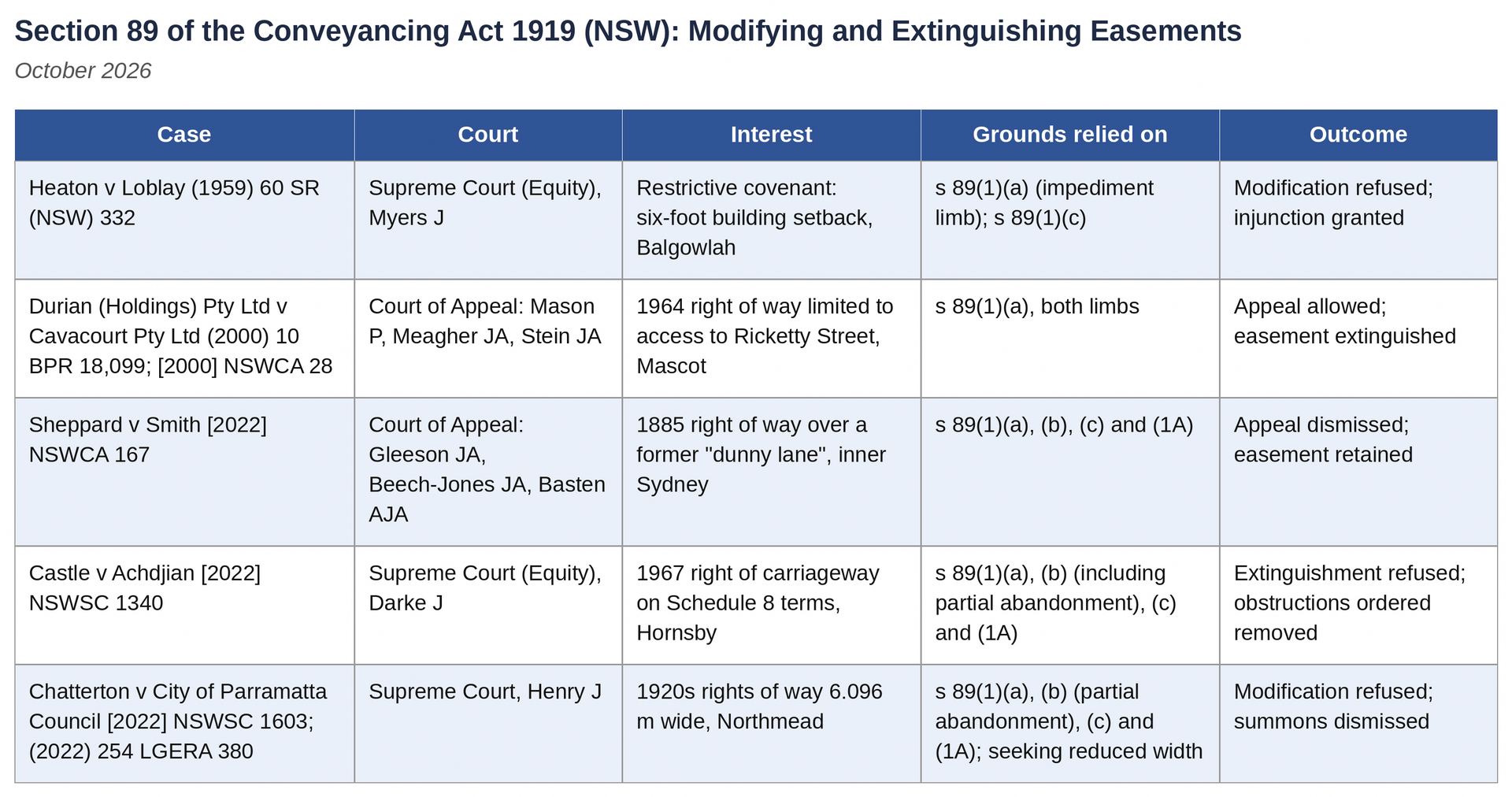
Each case summary in this article addresses the facts, issues, determination and key takeaways. The article then draws the threads together, focusing on when an easement secures no “practical benefit” and on the matters the Court weighs in determining whether to exercise its discretion and extinguish an easement or restriction on title.
The statutory framework
Section 89(1) empowers the NSW Supreme Court, “on the application of any person interested in the land”, to “modify or wholly or partially extinguish” an easement or restriction, upon being satisfied of one of several grounds. For easements, the relevant grounds are:
(a) that by reason of change in the user of any land having the benefit of the easement … or in the character of the neighbourhood or other circumstances of the case which the Court may deem material, the easement … ought to be deemed obsolete, or that the continued existence thereof would impede the reasonable user of the land subject to the easement … without securing practical benefit to the persons entitled to the easement … or would, unless modified, so impede such user, or
(b) that the persons … entitled to the easement … have agreed to the easement … being modified or wholly or partially extinguished, or by their acts or omissions may reasonably be considered to have abandoned the easement … wholly or in part …
(c) that the proposed modification or extinguishment will not substantially injure the persons entitled to the easement…
Section 89(1A), inserted by the Real Property and Conveyancing Legislation Amendment Act 2009 (NSW), adds that for the purposes of para (b) “an easement may be treated as abandoned if the Court is satisfied that the easement has not been used for at least 20 years before the application under subsection (1) is made.”
The grounds in section 89 (1) are alternatives, and applicants commonly plead all of them, as in Sheppard, Castle and Chatterton. Paragraph (a) contains two distinct limbs: obsolescence, and impediment to reasonable user without practical benefit (Chatterton at [98]). Paragraph (b) covers agreement and abandonment, in whole or in part. Paragraph (c) stands on its own.
Paragraphs (a), (b) and (c) of Section 89 ask different questions. As Myers J explained in Heaton, under para (a) “the inquiry concerns the effect of the restriction or its effect if it is not extinguished or modified”, whereas under para (c) “the inquiry concerns the effect of the desired modification”. The applicant bears the onus on each ground.
Satisfying a ground does not end the inquiry. In Mason P’s words, the power “requires proof of one or more circumstances to the satisfaction of the court coupled with the favourable exercise of a judicial discretion” (Durian at [2]).
Case 1: Heaton v Loblay (1959) 60 SR (NSW) 332
Facts and background
The plaintiff owned a cottage at Balgowlah built close to its boundary with an adjoining allotment, which she also owned until September 1956. On selling the allotment she imposed a covenant, annexed to her land, that no building or structure (other than eaves and guttering up to two feet wide) would be “erected or permitted to remain within six feet from the southern boundary”.
The defendants bought the allotment in 1957 and began building a substantial cottage. Their plans included a terrace about 19 feet long, fitted with a fireplace for cooking and plainly intended for entertaining. It was a suspended concrete slab running to the common boundary and supported there by a brick wall between three and seven feet high. The terrace would sit at about the level of the plaintiff’s front verandah, roughly 12 feet away.
The plaintiff was elderly, her husband was almost bedridden, and her son had afflictions that made privacy desirable; both men used the verandah for rest and recreation. The plaintiff sought an injunction. The defendants denied breach of the covenant, alleged acquiescence by the plaintiff and applied under s 89 to modify the covenant.
Issues
The issues were whether the terrace would breach the covenant; whether the plaintiff had acquiesced to the breach; whether the covenant’s continued existence would impede the reasonable user of the defendants’ land without securing practical benefit to the plaintiff (s 89(1)(a)); and whether the proposed modification would not substantially injure the plaintiff (s 89(1)(c)).
Determination
Myers J held that the terrace would breach the covenant, since both parties’ architects described it as an integral part of the building. The acquiescence defence failed because the defendants could not show they had made it sufficiently clear to the plaintiff that the terrace would extend to the boundary.
On s 89(1)(a), his Honour drew “a clear distinction” between paras (a) and (c) and laid down what has become the governing test for the impediment limb:
It follows that if application is made under par. (a) it is not sufficient to show that what the applicant proposes to do is a reasonable user of the land. It must appear if extinguishment is sought that no reasonable user of the land is possible unless the restriction is extinguished or if modification is sought that no reasonable user is possible unless the restriction is modified.
The paragraph looks not to the present owner’s plans but “to the use which can be made of it in the hand of any owner.” The land could “be used quite well for residential purposes whether the restriction is modified or not”; all the defendants would lose was “the added attraction of the terrace”. That made it unnecessary to decide whether the covenant secured a practical benefit, though his Honour indicated he would have found against the applicants on that point as well.
On s 89(1)(c), the only question was whether the modification would substantially injure the plaintiff, and it would. Expert evidence that her property would not lose value was beside the point: loss of value is not decisive, and where “the covenant was not exacted to preserve the value of the covenantee’s land but for another and different purpose, value is not a factor at all.” Having twice visited the land, Myers J found the terrace would seriously diminish the family’s privacy. There was “a sensible and substantial difference” between a terrace six feet from the boundary and one built right on it.
His Honour also rejected the argument that injury must be measured by an ordinary reasonable person’s reactions: a person “unduly sensitive to particular things” may exact a covenant to protect themselves. The injunction was granted and the s 89 application dismissed with costs.
Key takeaways
Heaton is the source of the “no reasonable user” test, which remains the standard for the impediment limb of s 89(1)(a) and was applied in both Castle (at [54]) and Chatterton (at [105]). The test is objective and owner-neutral: it asks whether the burdened land can reasonably be used by anyone, not whether the applicant’s preferred project is reasonable.
The decision establishes that paras (a) and (c) of section 89 ask different questions, and that substantial injury is not confined to financial loss. Privacy, amenity and the particular purpose for which a right was bargained can each found injury, even where an ordinary person might not feel the loss as keenly.
Although Heaton concerned a restrictive covenant, its reasoning has been applied to easements without qualification.
Case 2: Durian (Holdings) Pty Ltd v Cavacourt Pty Ltd (2000) 10 BPR 18,099; [2000] NSWCA 28
Facts and background
The parties owned neighbouring industrial land on Ricketty Street, Mascot, both once held by the Minister for Public Works for flood prevention works. In 1964 the Minister granted Ansett Transport a right of way over what became Durian’s land (1–3 Ricketty Street) for the benefit of what became Cavacourt’s land (5–9 Ricketty Street). The grant permitted passage with or without vehicles, but only “for the purposes of gaining or having reasonable access to and from the dominant tenement from and to the public highways adjoining the servient tenement”, namely Ricketty Street.
When the easement was granted, the dominant land was “virtually landlocked”. Over the following decades it gained access to Gardeners Road and was consolidated with other lots, and all its traffic came to use Gardeners Road. From at least 1981 the boundary was marked by a half-metre brick wall or a wire fence with no gate, and the dominant land sat about 70 cm above the servient land. Durian used the easement site as a carpark under a 1988 development consent that required 83 paved, line-marked spaces.
Successive development consents for the dominant land confined vehicular access to Gardeners Road; the 1982 consent stated that “[a]ll vehicular access from the right-of-way off Ricketty Street is to be denied”.
Durian sought extinguishment of the easement under s 89. Young J refused the application, granting Cavacourt a declaration as to the validity of the easement and an injunction restraining Durian from trespassing on it. Durian appealed.
Issues
The issues on appeal were whether, under the first limb of s 89(1)(a), the easement ought to be deemed obsolete, and whether, under the second limb, its continued existence would impede the reasonable user of Durian’s land without securing practical benefit to Cavacourt.
Determination
The Court of Appeal unanimously allowed the appeal and ordered that the easement be extinguished.
Mason P set out the governing approach. Adopting Jacobs J in Re Mason and the Conveyancing Act [1962] NSWR 762 at 764, “obsolete” can be taken to mean “that the object of the covenant is now incapable of fulfilment or perhaps that it serves no present useful purpose”, bearing in mind “the latitude encompassed in a power expressed as one of being satisfied that the easement ‘ought to be deemed obsolete’”. However, the focus must remain the statutory language:
Section 89 necessarily qualifies the common law rights of the owner of the easement. The section is to be applied according to its terms, read fairly and without disregarding the conventional approach to legislation affecting common law property rights. The starting point is the easement itself, its terms and its objects derived from construing those terms in context … and bearing in mind that the easement was created for an indefinite future and destined to enure in a changing environment.
His Honour accepted the caution in Re Henderson’s Conveyance [1940] 1 Ch 835 that the power in section 89 is not designed to allow one owner to expropriate another’s private rights for profit. But “[t]he converse is equally true”: it is no defence to a claim properly brought under s 89, that the dominant owner might extract money from a servient owner anxious to develop.
On the facts, the easement’s “expressed and only purpose” was access to Ricketty Street. It had not been used for that or any purpose for almost 30 years. It was physically blocked, access was available via Gardeners Road, and enforceable planning restrictions made the use impermissible. Mason P noted that “[t]here is no suggestion of usage or need for usage of the easement by pedestrians.” Both limbs of s 89(1)(a) were made out.
Young J had considered the easement not obsolete because access via the easement had been a “selling point” when Cavacourt acquired the land and had value for more flexible use. Mason P held that this “subjective consideration” could not defeat the case: the easement “is no longer capable of useful fulfilment in any practical sense other than as a mere bargaining tool in the hand of the dominant tenant.”
Meagher JA, “with great hesitation”, relied on non-use since at least 1971, the new Gardeners Road access, the reconfiguration of the site, physical obstructions since 1981 and, “perhaps the greatest factor”, planning restrictions making the original use “impossible, and now even illegal”. Stein JA observed that “[i]f ever there was an easement which is obsolete … it is this one.”
Key takeaways
Durian remains the leading appellate statement of the obsolescence test and was applied in Sheppard, Castle and Chatterton. Its outcome, however, turned on an unusual combination: an easement expressly confined to a single purpose, alternative access that made the purpose unnecessary, and planning controls that made it unlawful. Later courts have consistently distinguished Durian on precisely those features.
The case is also the principal authority on what does not count as practical benefit. A dominant owner’s view that the easement is a “selling point”, or its value as a bargaining chip, is not enough. Expert evidence of benefit or value that assumes the easement can be used carries little weight where the real question is whether it can be.
Finally, the Court expressly noted the absence of any pedestrian use or need. That observation has proved decisive in later cases, where pedestrian use kept nominally vehicular easements alive.
Case 3: Sheppard v Smith [2022] NSWCA 167
Facts and background
The parties owned adjoining terraces in inner Sydney: the appellants owned “Number 6” and the respondents “Number 8”. An 1885 conveyance reserved for Number 8 “a right of way over a passage along the western and southern boundaries of the remaining part of Lot three”, an L-shaped laneway 1.045 m wide along the side and rear of Number 6. Its purposes at least included removing “nightsoil”; colloquially referred to in Sydney as a “dunny lane”. The strip only became part of Number 6’s title in 2019, when the appellants obtained possessory title subject to the right of way.
After sewers were connected in about 1908 the lane fell into disuse. Fences were extended across it, and successive owners of Number 6 built a gate at the street, a raised garden bed, a fishpond and a roofed area over the lane. There was no evidence that Number 8’s owner from 1956 to 2008, Ms McJannet, ever used or asserted the right.
The respondents bought Number 8 in 2008 and, when lodging a delimitation plan in 2010, took “active steps” to have the right of way recorded on their title. They later built a gateless paling fence, a metal post and a knee-high concrete wall that impeded access, and for some years kept a shed nearby. The appellants, who bought Number 6 in 2012, enclosed the covered area as a room extending across the lane. In 2019 the council required removal of the structures, with enforcement deferred pending the proceedings.
The appellants sought extinguishment of the right of way under every limb of s 89(1), together with s 89(1A). Parker J dismissed the application ([2021] NSWSC 1207), and the appellants appealed.
Issues
The appellants contended that the primary judge erred in rejecting abandonment by both the respondents and Ms McJannet, including by giving weight to the 2010 notation and to subjective intentions; in finding the easement not obsolete; and in requiring them to show that future use was “so remote”, and the easement’s value “so small”, as to be of no substance.
Determination
Beech-Jones JA, with whom Gleeson JA and Basten AJA agreed, dismissed the appeal.
On abandonment, his Honour confirmed that it is a finding of fact, drawn by “taking into account all the matters of fact which may tend towards or against” that conclusion (Treweeke v 36 Wolseley Road Pty Ltd (1973) 128 CLR 274). What is required for abandonment is “a firm intention that neither he nor any successor in title of his should thereafter make use of the easement”, and abandonment “is not … to be lightly inferred”. Non-user alone is insufficient, although acquiescence in obstructions inconsistent with the right may support the inference that it has been abandoned.
Recording the right of way on the title of No. 8 was decisive in demonstrating an intention to keep the right of way. “Taking specific steps to record the existence of a right of way onto a certificate of title which is then available to anyone who searches the register is a very public form of affirmation of the existence of the right of way.”
Non-user was not treated as neutral, but had to be weighed in context: the lane was not trafficable, and the respondents had an alternative route to the street through their front door. The paling fence and post were cheap to modify or remove, no different in substance from the fencing in Treweeke. Their form was “very much consistent with a lack of an immediate intention to use the right of way” but was “little, if any, evidence of a permanent intention to abandon”. The knee wall impeded, but did not preclude, access.
As to Ms McJannet, there was simply an absence of evidence. There was nothing to show she asserted the right or objected to the obstructions, but equally nothing to show she knew of the right or expressed any intention to abandon the right of way. Such absences, coupled with no evidence of knowledge of the right of way, do “not translate to a finding of acquiescence”.
Beech-Jones JA also expressed “strong doubts” that later assertions of the right could subvert the power in s 89 arising once abandonment had occurred. The primary judge’s construction of s 89(1A), under which 20 years of non-user suffices only where no other evidence negates an intention to abandon, was not challenged, and the respondents’ manifest intention to retain the right was fatal to reliance on 20 years of non-user.
On obsolescence, Durian did not assist the appellants. “The critical factors pointing to obsolescence in Durian were the limited nature and purpose of the right of way and that subsequent events rendered the use of the right of way unable to achieve that purpose”; non-use and obstructions “simply confirmed” that conclusion. Here the grant was unqualified, nightsoil removal was only one of its purposes, and apart from the sewers there had been no relevant change in the character of the neighbourhood.
His Honour rejected the argument that Durian made the respondents’ intentions irrelevant. What was irrelevant there in Durian was the opinion that the easement was a “selling point”; by contrast, “[a] genuine intention to use the right of way is not irrelevant at least when accompanied by a realistic means to make the right of way trafficable”. Because the purpose was not limited to removal of nightsoil, the easement continued to secure a practical benefit. The primary judge had also rightly held that the need for expenditure to make the lane trafficable “does not mean that it is useless”, and that a “compressed” backyard did not establish an impediment to reasonable user.
On s 89(1)(c), the Court accepted that “substantial” means non-theoretical or having present substance rather than large (Re Mason), and that the onus lies on the applicant to demonstrate extinguishment will not substantially injure the persons entitled to the easement.
Key takeaways
Sheppard is the leading recent appellate statement on abandonment under s 89(1)(b). It confirms the demanding “firm intention” standard and shows that acts asserting the right, especially recording the right on a plan registered on title, will weigh heavily against abandonment. Temporary, inexpensive structures, even if built by the dominant owner, will rarely evidence a permanent intention to forfeit the right.
On obsolescence, the decision reinforces that the terms of the grant are the starting point. A general right of way is not obsolete simply because one historical purpose has disappeared. The Court also clarified Durian: a genuine intention to use, coupled with a realistic means of making the way usable, is relevant; a subjective view about value is not.
For applicants relying on s 89(1A), the case confirms that 20 years of non-user does not automatically produce abandonment where other evidence negates that intention. It also casts doubt on the proposition that a completed abandonment can be cured by later assertions of the right.
Case 4: Castle v Achdjian [2022] NSWSC 1340
Facts and background
A 1967 deposited plan at Hornsby created a ten-foot “right of carriageway” along the eastern edge of 8 Marlee Street (Lot 29, owned by the defendants since 2000) for the benefit of 20 Vista Close (Lot 30), which backs onto Lot 29. Because the s 88B instrument used only the words “right of carriageway”, the easement incorporated the Schedule 8 terms: a right “to go, pass and repass at all times and for all purposes with or without animals or vehicles or both”. Lot 30 slopes steeply from Vista Close down to its rear, and Lot 29 continues to fall towards Marlee Street.
No driveway or path was ever built on the easement site. The easement was blocked for many years by gateless fences at each end and, from about 2011, by a further fence with a gate midway along. A large pine tree grew within it. The Court accepted that the children of the previous owners of Lot 30, the Ryans (1974–2020), climbed the rear fence and used the strip as a shortcut to Marlee Street from about 1983 until 2005.
In 2010 the defendants’ conveyancers asked the Ryans to cancel the easement so that the defendants could extend their house, later offering $5,000 plus costs. Mr Ryan refused, recording that he “was interested in using it for access in due course”. The defendants redesigned their renovation to avoid the easement, but associated works (a front fence, the midway fence and garden retaining structures) encroached on it.
The plaintiffs bought Lot 30 in November 2020, having seen it marketed with “rear access via Marlee St”, and sought removal of the three fences when the defendants resisted their use of the easement. The defendants cross-claimed for extinguishment of the easement or, alternatively, a finding that only a right of footway survived. Their experts said a driveway along the easement could not meet design standards and was most unlikely to be approved.
Issues
The issues were whether the easement ought to be deemed obsolete; whether its continued existence impeded the reasonable user of Lot 29 without securing practical benefit to Lot 30; whether it had been abandoned wholly or in part, including by reason of s 89(1A); whether extinguishment would not substantially injure the plaintiffs; and whether the defendants should be ordered to remove the fences.
Determination
Darke J dismissed the cross-claim and granted the plaintiffs substantial relief, ordering removal of the fences obstructing the right of carriageway.
On obsolescence, His Honour applied Durian, beginning with the easement’s terms construed in context: a residential subdivision on sloping land. Vehicular access was “undoubtedly one purpose”, but the terms also allowed non-vehicular access, and both could be seen as parts of “a more generally expressed purpose of access between the rear of Lot 30 and Marlee Street”. The rear fence could be “quite easily and inexpensively removed”.
The evidence “firmly suggests that vehicular access … is unlikely to be achievable along the right of carriageway”. Nevertheless, once the fences were opened and light vegetation cleared, “the easement could be conveniently used for pedestrian access”, and its surface might be improved for bicycles. His Honour accepted as genuine Mr Castle’s reasons for walking the route: taking his children to the local primary school, and reaching a park and shops.
That distinguished Walker v Bridgewood (2006) 12 BPR 23,537, where there was no good reason for anyone to use the way on foot. Durian was also distinguishable: it was an industrial case with an expressly limited purpose, no pedestrian need, and a use that had become “even illegal”. The easement was “not an easement of no practical utility which ought be removed in order to ‘clear the title’”.
On the impediment limb, Darke J applied Heaton: it must be shown that “no reasonable user of the land is possible unless the easement is extinguished”. The defendants’ complaint depended on a driveway being built, which might well make reasonable residential use of their land impossible. But since council approval was most unlikely, the easement could not be said to impede reasonable use in that way. And because pedestrian use was available, it did secure practical benefit to the dominant owner.
On abandonment, his Honour thought an application is likely “made” for the purposes of s 89(1A) when filed rather than heard; either way, use by the Ryan children until 2005 meant 20 years of non-use could not be shown. The original owners’ acceptance of a gateless rear fence showed no immediate intention to use the way, but the fence was readily removable. The Ryans’ rejection of the 2010 offer and stated intention to use the easement “in due course” were inconsistent with abandonment, and the defendants’ later works were “not major impediments”.
The alternative case of partial abandonment, leaving only a footway, also failed. Drawing on Needham J in Proprietors Strata Plan No 9968 v Proprietors Strata Plan No 11173 [1979] 2 NSWLR 605 and Young J in Finlayson v Campbell (1997) 8 BPR 15,703, his Honour noted the difficulty of applying partial abandonment to a right of carriageway, “especially where, as here, some use has been made of the right. Such use necessarily entails an assertion that the easement exists.”
On s 89(1)(c), applying Re Mason, the loss of pedestrian access between the rear of Lot 30 and Marlee Street “would be a substantial injury”. As no ground was established, the discretion was not reached. His Honour noted, however, that the plaintiffs’ purchase partly in reliance on the easement shown on the title, and the defendants’ failure to seek extinguishment earlier, might have been relevant (Pieper v Edwards).
The front and midway fences, erected by the defendants in about 2011, were actionable nuisances, and mandatory orders for their removal were to be made. The rear fence, built by agreement with the Ryans at shared cost, was not, though the plaintiffs could remove it themselves. The defendants were ordered to pay the plaintiffs’ costs.
Key takeaways
Castle shows that a right of carriageway that may never carry a car can still have real utility. Where its terms allow pedestrian use and there is a genuine, realistic prospect of such use, the easement will not be obsolete, will secure practical benefit, and its loss will be a substantial injury.
The decision is a cautionary tale for servient owners relying on planning constraints in support of arguments that an easement may not have utility. The improbability of council approval for a driveway helped show that vehicular use was unlikely, but it also undermined the impediment argument: an easement cannot impede the servient land by reference to works that will never be built.
The case makes partial abandonment of a right of carriageway difficult to establish where the right has been used in any mode. It also confirms that a servient owner who obstructs an easement without the dominant owner’s agreement risks mandatory removal orders and costs if a s 89 application fails.
Case 5: Chatterton v City of Parramatta Council [2022] NSWSC 1603
Facts and background
In 1922 and 1923 the owners of rural land at Northmead sold two landlocked parcels of agricultural land. Each was granted a right of way 20 feet (6.096 m) wide and 65.84 metres long along the eastern boundary of what is now Lot 56 in Mary Street, to reach a public road. The grants were broad: for the transferee and “all other persons authorised by him or them for all purposes … at all times … to pass and re-pass with or without horses, cattle and other animals, carriages, carts, motors (sic) and other vehicles of all descriptions over and along” the strip.
A century later the neighbourhood had become suburbia. One dominant parcel was now Northmead Reserve, council-owned community land with baseball fields, a playground, an internal road and a carpark. The other had been subdivided in 1968 into about 68 residential lots with their own street access, and by 1994 structures on the Reserve had narrowed their connecting right of way to footpath width.
On Lot 56, timber bollards and a large metal bin were placed on the strip in the early 1980s, and in 1995 the plaintiffs’ father erected a high fence along the southern boundary with double gates across the strip. A neighbour complained to the then council, after which the gate was propped open, and complained again in 2008 when a builder’s fence obstructed the way. A worn path ran along the strip, used daily by residents walking, cycling and pushing prams, and by students of an adjoining school for students with intellectual disabilities.
The plaintiffs inherited Lot 56 in 2019. After a failed auction, they applied under s 89 to extinguish the right of way, and at the hearing confined their claim to reducing the right of way to 1.5 m or another width the Court considered appropriate. Mr Chatterton accepted that they had no plans to develop and sought the modification to obtain a better price. The council opposed. Notice was sent to the subdivided lot owners and advertised; none appeared, but some residents gave evidence for the council.
It was common ground that the use of the land and the character of the neighbourhood had changed dramatically. It was also agreed that, apart from Lot 56’s owners and their invitees, there had been no vehicle use for at least 20 years and no use by horses or cattle.
Issues
Henry J identified four issues: whether the right of way, as to its width, was obsolete or impeded the reasonable user of Lot 56 without securing practical benefit; whether it had been abandoned in part; whether the proposed reduction in width would substantially injure the persons entitled; and, if a ground was made out, how the discretion should be exercised.
Determination
Henry J dismissed the plaintiff’s claim.
His Honour began with construction. Despite the absence of the words “to and from”, the grants did not entitle the council or its invitees to pass through the Reserve to land beyond it; the general rule in Harris v Flower (1904) 74 LJ Ch 127, as explained in Westfield Management Ltd v Perpetual Trustee Co Ltd (2007) 233 CLR 528, applied. The school’s use of the strip as part of a neighbourhood walking loop was therefore of little weight. But members of the public authorised by the council to go to and from the Reserve were persons whose use and views the Court could consider.
The plaintiffs did not press obsolescence, and Henry J considered that an appropriate concession. Change in use and character is not enough unless the purpose of the right, which included pedestrian access between Mary Street and the Reserve, can no longer be achieved.
On the impediment limb, his Honour described the concept of reasonable impediment as “a narrow one”. An applicant “must demonstrate that the unmodified easement hinders, to a real and sensible degree, the land being reasonably used, having due regard to the situation it occupies, to the surrounding property and the purposes of the easement”. The plaintiffs invited the Court to infer impediment from the fact that the strip covered almost a third of the lot’s width. Henry J declined. There was no evidence that the easement prevented an extra storey, an extension, a new house or even multi-unit housing on the western side; no evidence of any reduction in value; no development plans; and the lot had always been reasonably used as a residence.
The right of way in its current form plainly secured practical benefit, given its pedestrian use. However, his Honour said that, had it been necessary, he would have concluded that its continued existence “for use with horses, cattle, carts and motor vehicles does not secure any practical benefit” to the council or the lot owners, given the alternative vehicular access and the changes in the neighbourhood.
On partial abandonment, Henry J was prepared to infer that the subdivided lot owners had abandoned the right other than for pedestrians, cyclists and mobility aids. The council’s position was different: its non-use by vehicles was explained by alternative access, the obstructions were easily removable, and the 1995 and 2008 complaints, followed by the gate being propped open, showed rights being asserted. Applying Castle, his Honour was “not convinced” that non-use of particular modes of enjoyment showed a firm intention not to use the full width. Section 89(1A) could not apply where pedestrians and cyclists had used the way throughout the 20 years before filing.
The decisive issue was s 89(1)(c). Henry J emphasised that practical benefit concerns the effect of the easement if left unmodified, whereas substantial injury concerns the effect of the proposed modification. A loss of practical benefit may, but need not, amount to substantial injury. The injury may be intangible, and the Court may consider its effect on members of the public authorised by the council to use the way.
Removing the right to drive along the strip would not cause substantial injury. With sealed roads giving direct access to the Reserve and a walk along the strip taking “a minute or so”, the loss of vehicular rights would be “mere theoretical injury”. Reducing the width to 1.5 m or 1.8 m was another matter. It would cut the usable area by 70–75%, move users away from the worn path, and make it hard for prams, bikes, wheelchairs and groups to pass, particularly where the strip was shared with vehicles using Lot 56’s driveway.
The council’s expert, a council-employed landscape architect, was treated “with caution”, but the standards she cited gave “some objective guidance”. A 3.5 m width fared no better: it would overlap much of the driveway, leaving pedestrians to step off the way, and trespass, to avoid a car. “The loss of amenity and the prospect of a less safe passage by pedestrians” was an injury of substance, even without evidence of financial impact.
As no ground for extinguishment under s 89 was established, the discretion did not arise, although Henry J outlined the matters that would have been relevant (discussed below).
Key takeaways
Chatterton shows that practical benefit and substantial injury can be assessed component by component. The Court was prepared to find that the vehicular and animal rights secured no practical benefit and could be removed without substantial injury. The plaintiffs, however, did not seek that modification, and the width they targeted continued to deliver real amenity and safety.
Applicants must frame their proposed order carefully and support it with evidence. The impediment case failed for want of evidence (no development proposal and no valuation), and the substantial injury case failed because the proposed widths did not reflect how the right of way was actually used.
Finally, the plaintiffs’ candid aim of a better sale price sat uneasily with the principle that s 89 is not designed to let one owner expropriate another’s rights for profit.
Conclusion
Section 89 gives the Court a genuine power to adapt the register to a changing world, but the five cases show that it is reserved for easements that have truly outlived their usefulness. A right granted for an indefinite future is not lost merely because it is unused, inconvenient to the servient owner, or no longer exercised in the way its original parties envisaged.
Durian marks the outer limit. There, a narrowly framed easement had become unnecessary, physically blocked and unlawful to use for its only purpose, and had no pedestrian dimension. The 2022 decisions show how rarely those conditions coincide. In Sheppard, a nineteenth-century dunny lane survived because its grant was general and its owners had publicly affirmed it. In Castle, a right of carriageway that may never carry a car survived because it could be walked. In Chatterton, a 6 metre right of way survived intact because its width served the safety and amenity of the people who used it, even though its vehicular and animal rights had lost their utility.
For servient owners, the lessons are to construe the grant first, gather evidence of how the easement is actually used, frame the order narrowly, and avoid self-help. For dominant owners, recording, asserting and genuinely planning to use the right are the best protection. For purchasers on either side, the register remains the anchor: what is on the title will generally stay there unless the strict requirements of s 89 are met.
Disclaimer
The contents of this article are a general guide and intended for educational purposes only. Determination of the types of issues discussed in this article is complex and often varies from case to case and involves an understanding of matters of fact and degree. Opinions on those matters can vary and be matters on which reasonable minds may differ.
DO NOT RELY ON THIS ARTICLE AS A SUBSTITUTE FOR COMPETENT LEGAL ADVICE.
Browse by categories

Servicing all of NSW, Whiteacre provides expert property law and planning and environment law advice and assistance.
✓ Planning Law Advice
✓ Land and Environment Court Appeals
✓ Voluntary Planning Agreements and Contributions
✓ Development Control Orders and Enforcement
✓ Property Development Advice and Due Diligence
✓ Title Structuring
✓ Easements and Covenants
✓
Strata and Community Title legislation
Book an initial consultation through our website with our planning law solicitor. Whether it's about planning and environment law or property law, you can approach us and discuss your matter to make sure we are a good fit for your requirements.